
What PTs can learn from astronauts, a relay, and exercising in space.
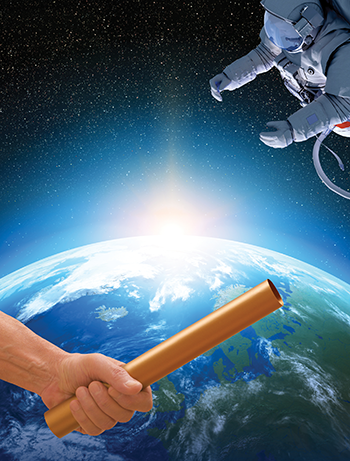
Feature Space 1

The zero gravity of space can lead to bone and muscle loss. The tools used by astronauts to strengthen their bones and muscles have value on Earth, as well.

When Tim Flynn, PT, PhD, OCS, FAAOMPT, began running the Wild West Relay (WWR) in Colorado last August as part of a 6-person team, he wasn't new to the experience. Over the years, Flynn has run the relay several times, even with some of the same team members. What was different this time, though, is that 1 of the team members wasn't physically with the team.

In fact, teammate Steve Swanson, PhD, was over 200 miles away. But not elsewhere in Colorado, or even a neighboring state. In fact, Swanson was out of this world—literally. He was running his legs of the race from outer space.

Log in or create a free account to keep reading.


Join APTA to get unlimited access to content.

  1. Relay races. Roads Less Traveled Relays. http://www.rltrelays.com/wild-west-relay. Accessed January 8, 2015.
  2. Flynn T. Dreaming Big. EIM. July 31, 2014. EvidenceinMotion.com/about/blog/2014/07/dreaming-big/. Accessed January 8, 2015.
  3. International Space Station. NASA. http://www.nasa.gov/mission_pages/station/research/experiments/765.html. Accessed January 8, 2015.
  4. Wood SJ, Loehr JA, Guilliams ME. Sensorimotor reconditioning during and after spaceflight. NeuroRehabilitation. 2011;29(2):185-95. doi: 10.3233/NRE-2011-0694.

You Might Also Like...

Article

2027 McMillan, Maley Lectures to Feature Leaders in Research and Education

Two accomplished leaders whose work has influenced physical therapist education, research, and patient care will take the stage at APTA Combined Sections

Article

Value-Based Care: APTA Resources to Help You Prepare

Explore tools, practical guidance, real-world examples, and member insights to help physical therapists navigate the shift to value-based care.

Article

What 2 DPT Students Learned at the Special Olympics USA Games

At the 2026 Special Olympics USA Games, held June 20-26 in Minneapolis, both students and experienced clinicians alike volunteered in roles that reinforced